After the Affair
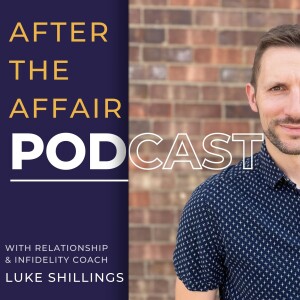
The ‘After the affair’ podcast with Luke Shillings is here to help you process, decide, and move forward on purpose following infidelity. Let’s explore what’s required to rebuild trust not only in yourself, but also with others. Whether you stay or leave, I can help! and no matter what your story, there will be something here for you.
Listen on:






Episodes
Wednesday Nov 26, 2025
Wednesday Nov 26, 2025
If you’ve been asking yourself, “Why am I still suffering after betrayal?”, this episode is for you.
Most people think they’re drowning because the pain is too big.
But the real reason you’re stuck isn’t the pain itself… It’s the suffering your mind is unintentionally creating on top of it.
In today’s episode, Luke breaks down the crucial difference between discomfort (the natural emotional pain of betrayal) and suffering (the mental loops, fear-based stories, and catastrophic thoughts that keep you stuck).
You’ll learn exactly why betrayal creates so much mental noise, why you can’t “think your way out” of it, and how to finally stop adding suffering to pain you’re already strong enough to survive.
If you’re tired of feeling overwhelmed, anxious, and trapped in your thoughts, this episode will show you why you’re suffering and how to stop.
Key Takeaways
Discomfort = the honest, human pain of betrayal.
Suffering = the mental stories you add on top of the pain.
Discomfort moves. Suffering loops.
Betrayal triggers the nervous system — making suffering feel inevitable.
Your mind fills uncertainty with worst-case scenarios to feel “safe.”
You can’t avoid discomfort, but you can avoid suffering.
Learning the difference changes everything.
If you’re stuck in suffering, not because you’re weak, but because nobody taught you how to separate pain from interpretation, coaching can help.
Inside The After the Affair Collective and through one-to-one coaching, Luke teaches you how to stop the mental loops that keep you stuck and build a calmer, clearer, more grounded recovery.
Start your next chapter at lifecoachluke.com
Or reach out directly, you don’t have to do this alone.
Connect with Luke:
Website: www.lifecoachluke.com
Instagram: @mylifecoachluke
Email: luke@lifecoachluke.com
Wednesday Nov 19, 2025
Wednesday Nov 19, 2025
If you’ve been going to therapy after betrayal and still don’t feel any better, you’re not alone, and you’re not broken.
Most people stabilise through therapy but then hit a wall. They can explain the affair, understand their childhood patterns, name their triggers… and still wake up every day feeling overwhelmed, anxious, or completely stuck.
In this episode, Luke breaks down why this happens, and it has nothing to do with failure or inadequacy.
You’ll learn how betrayal dysregulates the nervous system, why therapy is essential but not always enough on its own, and the specific ways coaching creates the forward momentum you’re craving.
Luke also shares a powerful analogy about the rope and the hole, illustrating how therapy helps you climb out of crisis, while coaching equips you with the tools to move forward once you’re out.
If you’ve ever thought, “I understand what happened… so why can’t I heal?” this episode will finally make things click.
💡 Key Takeaways:
Betrayal triggers a physiological trauma response, your nervous system needs stabilising first.
Therapy helps you understand and process the pain, but insight alone doesn’t create movement.
Feeling stuck after therapy is normal, it simply means you’re ready for the next phase.
Coaching bridges the gap between “I understand” and “I’m changing.”
Forward movement isn’t dramatic, it’s seen in micro-shifts, not giant leaps.
You know you’re ready to rebuild when you’re stable, curious, and wanting clarity more than comfort.
Connect & Continue the Journey
If therapy has helped you stabilise, but you’re ready for clarity, confidence, and forward movement, Luke can help you bridge that gap.
Explore one-to-one coaching or join The After the Affair Collective at lifecoachluke.com, where you’ll learn the tools to rebuild trust in yourself and move forward with intention.
Connect with Luke:
Website: www.lifecoachluke.com
Instagram: @mylifecoachluke
Email: luke@lifecoachluke.com
Tuesday Nov 11, 2025
Tuesday Nov 11, 2025
One of the most painful parts of betrayal is believing someone else was chosen instead of you.
It can feel like a verdict, proof that you weren’t enough, that your worth has been measured and found wanting.
But what if being chosen was never the measure of your value in the first place?
In this episode, Luke explores the deeply human craving to be chosen and how it becomes distorted after betrayal. He explains why comparing yourself to an affair partner keeps you trapped in a story that was never about you, and how to reclaim your worth from the false belief that someone else’s choice defines it.
If you’ve ever wondered, “Why them, not me?” this episode will help you find peace, clarity, and strength in remembering that your value was never up for debate.
Key Takeaways:
The desire to be chosen is deeply human, but it’s not the measure of your worth.
Betrayal distorts “being chosen” into comparison and self-blame.
An affair partner isn’t proof of your inadequacy, they’re a mirror reflecting someone else’s disconnection.
Being desired feels good, but when it becomes your evidence of value, you lose self-trust.
Healing begins when you stop needing to be chosen and start choosing yourself.
Connect & Continue the Journey
If today’s episode helped you see yourself more clearly, you don’t have to stop here.
Through one-to-one coaching and The After the Affair Collective, Luke helps people rebuild self-worth that doesn’t depend on being picked, proving, or pleasing.
Connect with Luke:
Website: www.lifecoachluke.com
Instagram: @mylifecoachluke
Email: luke@lifecoachluke.com
Wednesday Nov 05, 2025
Wednesday Nov 05, 2025
After betrayal, couples often feel like they’re living the same story, but in completely different timelines.
One partner feels miles ahead, ready to rebuild, while the other is still reeling from the shock.
This is The Lag - the time delay between awareness, understanding, and emotional readiness in the aftermath of infidelity.
In this episode, Luke explains how The Lag shows up in two major phases, first, the delay in awareness between the unfaithful and betrayed partner, and later, the difference in perception as healing begins.
He explores deeper layers too, emotional regulation, motivation, identity, and trust, showing how each partner can exist in a different emotional time zone even when they both want repair.
You’ll learn how to recognise The Lag, stop blaming each other for being “out of sync,” and start walking together again, even when your clocks don’t match.
Key Takeaways:
The Lag is the invisible time delay in awareness, understanding, and healing between partners after betrayal.
The unfaithful has been living the truth for longer, the betrayed is only just discovering it.
Emotional and physiological recovery move slower than cognitive understanding.
Rebuilding trust takes time, being consistent matters more than being “seen.”
The goal isn’t perfect synchrony; it’s staying connected while the clocks re-align.
Connect & Continue the Journey
If you’ve recognised The Lag in your own story, you’re not alone; it’s one of the most common patterns after infidelity.
Luke’s coaching and The After the Affair Collective community are designed to help you bridge that gap, building clarity, calm, and connection at your own pace.
Connect with Luke:
Website: www.lifecoachluke.com
Instagram: @mylifecoachluke
Email: luke@lifecoachluke.com
Wednesday Oct 29, 2025
Wednesday Oct 29, 2025
After betrayal, it’s common to feel paralysed, caught between wanting to fix things and fearing you’ll make the wrong move. Every decision feels heavy, every option uncertain.
In this episode, Luke explores the truth about indecision after betrayal and why waiting to feel sure is keeping you stuck.
He shares how our minds chase certainty to avoid pain, and how the real path forward begins with trust, not in others, but in yourself. If you’ve been living in limbo, this short, reflective episode will help you breathe again, take one small step, and start rebuilding from a place of calm and clarity.
Key Takeaways:
Indecision after betrayal isn’t weakness; it’s your nervous system trying to keep you safe.
Certainty is an illusion; it’s not the goal. Self-trust is.
Clarity doesn’t come before you act; it comes because you act.
You don’t need to know everything right now; you only need to take the next honest step.
Healing begins when you stop chasing control and start trusting yourself again.
Connect & Continue the Journey:
If today’s episode resonated with you and you’re ready to stop living in limbo, Luke’s coaching and community are here to help.
Visit lifecoachluke.com to learn more about private coaching and become a part of The After the Affair Collective, a supportive space for those navigating life, love, and healing after infidelity.
You don’t have to do this alone.
Connect with Luke:
Website: www.lifecoachluke.com
Instagram: @mylifecoachluke
Email: luke@lifecoachluke.com
Wednesday Oct 22, 2025
Wednesday Oct 22, 2025
Work is supposed to be a place of focus, structure, and shared goals, not secrecy and heartbreak.
Yet, for many couples, the workplace becomes the unexpected setting for infidelity.
In this episode, Luke explores why workplace affairs are so common, how emotional connections can quietly blur into something deeper, and what both partners can do when the affair partner still works in the same environment.
You’ll learn how proximity, power, and emotional displacement create conditions for connection, and how awareness, honesty, and intentional healing can turn even the most triggering situation into an opportunity for growth.
Key Takeaways
Workplace affairs rarely start with attraction. They often begin with emotional connection, validation, empathy, and shared stress that slowly cross invisible boundaries.
Proximity and permission create risk. Daily collaboration, late nights, and private communication can normalise intimacy that feels justified as “just work.”
Warning signs appear long before discovery. Emotional secrecy, defensiveness, and subtle boundary shifts are often early indicators of displaced energy.
When the affair partner still works there, safety becomes the priority. Rebuilding trust means removing ambiguity, not enforcing control. Transparency and consistent behaviour restore stability over time.
Healing is possible, even when the environment can’t change. It begins by creating safety within yourself, not waiting for perfect circumstances.
Dealing with this alone?
If you’re living in the aftermath of betrayal, especially when contact or reminders still exist, you don’t have to navigate this alone.
Through 1:1 coaching and The After the Affair Collective, Luke helps individuals move from surviving to rebuilding, with clarity, calm, and confidence.
Because healing isn’t about returning to who you were… it’s about becoming who you were always meant to be.
Connect with Luke:
Website: www.lifecoachluke.com
Instagram: @mylifecoachluke
Email: luke@lifecoachluke.com
Wednesday Oct 15, 2025
Wednesday Oct 15, 2025
AI can answer your questions, offer reassurance, even write the perfect breakup text. But can it really help you heal after betrayal?
In this episode, Luke explores the growing use of AI tools in emotional recovery, from journaling and reflection to replacing genuine connection, and asks an important question: What happens when your search for healing turns into another form of avoidance?
Luke unpacks:
Why we turn to AI when we’re hurting
The difference between reflection and relationship
How AI can support clarity, but not replace connection
The subtle danger of outsourcing your inner voice
How to use AI consciously, without losing your sense of self
Because real healing still begins where it always has, within you.
Key Takeaways:
AI can help you process thoughts, but it can’t meet emotional needs.
Healing requires human connection, not just understanding.
Be mindful of using AI to avoid feeling rather than explore feeling.
Technology is a tool, not a therapist.
Awareness is what keeps reflection from turning into dependency.
Connect with Luke:
Website: www.lifecoachluke.com
Instagram: @mylifecoachluke
Email: luke@lifecoachluke.com
Join the After the Affair community at www.facebook.com/groups/aftertheaffaircommunity
Wednesday Oct 08, 2025
Wednesday Oct 08, 2025
After infidelity, “safety” becomes the word we chase;- Emotional safety - Relational safety - Internal safety
But what does that actually mean? And how do you build it when trust has been broken?
In this episode, Luke explores the delicate balance between finding safety within yourself and rebuilding safety with your partner.
Because healing isn’t about becoming immune to pain or pretending you don’t need anyone, it’s about knowing how to meet yourself when the pain comes, and recognising who’s capable of meeting you there too.
In this episode, we’ll explore:
What “inner safety” really means (and what it doesn’t)
Why self-trust and relational trust are two sides of the same bridge
How to stop gaslighting yourself into accepting unsafe behaviour
The difference between chaos and connection
Why craving reassurance isn’t weakness, it’s wiring
If you’ve ever wondered whether it’s possible to feel safe again, both within yourself and in a relationship that’s been shaken by betrayal, this episode is for you.
Connect with Luke:
Website: www.lifecoachluke.com
Instagram: @mylifecoachluke
Email: luke@lifecoachluke.com
Join the After the Affair community at www.facebook.com/groups/aftertheaffaircommunity
Wednesday Oct 01, 2025
Wednesday Oct 01, 2025
Fight, Apologise, Repeat: Breaking the Cycle of False Hope
If you’ve ever felt stuck in the cycle of conflict and reconciliation, the fights that leave you questioning everything, followed by apologies that flood you with hope, this episode is for you.
Because while those moments of reconnection can feel powerful, they don’t always mean real change is happening. Sometimes, they just keep you hooked in a painful loop of false hope.
In this episode, I’ll explore:
Why the fight–make up cycle feels so addictive (hint: it’s not just emotional, it’s chemical).
How these constant highs and lows erode trust and clarity.
The difference between hope with evidence and hope based on words alone.
Practical ways to spot the cycle and start breaking free.
Why compassion is essential, both for the betrayed partner and the unfaithful one.
If you’re tired of riding this emotional rollercoaster, this conversation will give you the clarity to see the cycle for what it is, and the courage to choose something different.
Connect with Luke:
Website: www.lifecoachluke.com
Instagram: @mylifecoachluke
Email: luke@lifecoachluke.com
Join the After the Affair community at www.facebook.com/groups/aftertheaffaircommunity
Wednesday Sep 24, 2025
Wednesday Sep 24, 2025
When betrayal strikes, many couples attempt reconciliation. But what happens when it doesn’t work out? When the marriage itself doesn’t survive, and you’re left staring at a future you never planned for?
In this episode, I explore the emotional reality of life after infidelity when reconciliation comes to an end. We’ll talk about:
Why survival mode is not the same as healing.
The loneliness of everyday moments and how grief deepens when you lose the sense of “we.”
How to balance the demands of single parenting or solo living while still making space for your emotions.
Understanding the many different “parts” of you, and how to care for the wounded parts without letting them define you.
Why this difficult chapter can also be the beginning of rediscovering your own strength and creating a future that’s truly yours.
Whether you’re newly separated, in the middle of rebuilding, or simply fearing what the future might hold, this episode is here to remind you: you are not broken, and you are not alone.
Connect with Luke:
Website: www.lifecoachluke.com
Instagram: @mylifecoachluke
Email: luke@lifecoachluke.com
Join the After the Affair community at www.facebook.com/groups/aftertheaffaircommunity